
The Oracle Answers Itself
SEO · Zero-Click Search · AI Overviews · Digital Communities · June 2026
From Google I/O 2026 to the end of the click: a critical map of the SERP that answers itself. How zero-click search became the norm, how much traffic AI Overviews really take, and why they hit generic knowledge while sparing the purchase. And what breaks, beyond the editorial economy, when the oracle answers in place of the communities that built that knowledge: the forums, the third places, the weak ties that made the web a machine for being together.
At Google I/O 2026, on the stage in Mountain View, head of Search Elizabeth Reid used a phrase that, on a second listen, sounds less like a product announcement and more like a statement of intent: AI search through and through. The company called it the biggest transformation of the search box in twenty-five years. AI Mode at the center, conversational follow-ups, autonomous agents monitoring the web on your behalf. In the same talk came the number that explains the stakes: AI Mode has passed a billion monthly users, with a query volume that more than doubles every quarter.
For a quarter of a century, searching meant receiving a list of doors. Search was an index, a transit node that lived on the referral elsewhere. Since May 2026 the stated direction is the opposite. Search becomes a terminal node, a place where the answer arrives and curiosity stops. The physics of the gesture changes. And when the physics of a gesture performed billions of times a day changes, everything built on that gesture changes with it.

What Zero-Click Search Is and Why It Became the Norm in 2026
A zero-click search is a search that ends on the results page, without the user visiting any site. In 2026 it is no longer a statistical exception but the prevailing behavior. SparkToro, using Similarweb clickstream data on US Google traffic from the start of the year, places no-click searches at around 68 percent; other measurements settle on 64.8 percent. The range depends on definitions, but the direction has been unambiguous for years and predates AI Overviews: featured snippets, knowledge panels and local packs had already moved the answer inside the page. AI Overviews accelerated a process already underway, they did not invent it.
The point many companies have not yet absorbed into their digital plan is that zero-click search is not a transitional phase to pass through. It is the new baseline condition. The share of the open web reachable by search engines shrinks year after year, and the migration toward ChatGPT, Perplexity and Gemini drains queries from Google even before Google resolves them internally.
How Much Traffic Do AI Overviews Really Take
The honest answer is that it depends on the intent of the query, the position and the measurement window, and that anyone who gives you a single number is selling you a simplification. The review of twelve studies compiled by IDEAVA finds a click-through drop wherever an AI Overview appears, with a magnitude swinging between 15 and 89 percent. Ahrefs, repeating in December 2025 the same study run in April on 300,000 keywords, went from a 34.5 percent drop to a 58 percent one on the first organic result for informational queries. Measurements that weigh a site’s entire traffic, and not just informational position one, record more contained average drops, around 18 percent.
Applying 58 percent to your whole traffic overstates the damage for most e-commerce and understates it for editorial sites heavily dependent on head informational queries. The right figure for a meeting with stakeholders is the one segmented by intent, not the most dramatic one.
Why AI Overviews Hit Informational Queries and Spare Transactional Ones
Because they hit where there is an answer to synthesize and spare where there is a purchase to complete, and this selectivity is not technological neutrality: it is the signature of an economic mechanism. The 2026 Seer update, on 5.47 million queries, shows that an AI Overview appears on 36 percent of informational queries, against 8 percent of commercial ones and 5 percent of transactional ones. On the behavioral side the Semrush segmentation is even sharper: informational queries resolve without a click in 74 percent of cases, transactional ones keep bringing clicks in 69 percent.
The informational layer of the web, the “what is,” the “how does it work,” the “why,” is exactly what Google is absorbing and returning as a free answer. The transactional layer, “buy,” “price,” “sign up,” is what stays intact. Not out of generosity. It is the layer where the ad auction that generates revenue lives. The system preserves the click where the click produces rent for whoever hosts it, and removes it where someone else’s content can fund the answer for free.
The content you produced feeds a system that doesn’t cite you and doesn’t pay you.
There is one data point that prevents closing the discussion with the word “theft,” and it must be kept because it is more uncomfortable than the simple thesis. Seer found that, after eighteen months of decline, organic CTR on queries with an AI Overview rebounded 85 percent in two months. There is a quality paradox: the clicks that survive convert 23 percent more, because whoever clicks has already read the synthesis and is looking for depth. And queries with a brand name, in the presence of an AI Overview, see click-through rise by nearly 19 percent. The correct reading is that AI Overviews are not hostile to traffic in general. They are hostile to generic informational authority and permissive toward already-recognized brand authority. Those who have a name get confirmed. Those who produce knowledge without a name become an unpaid source. This is a restratification, not a subtraction, and for a small publisher it is worse news than any percentage of decline.
How to Recover Traffic After AI Overviews
The move that works in 2026 is not chasing the lost traffic but segmenting the editorial portfolio by intent and changing the metric by which each category is judged. Head informational content is now a citation play, not a traffic one: the correct metric becomes how often Google cites you in its answers and the brand recall that follows, not sessions. Whoever keeps measuring a “what is” article in clicks is measuring the wrong thing.
In parallel it pays to hold the queries where the click still exists, the transactional ones, the local ones, the high-intent comparisons, and to build brand depth and trust signals, because they are the only moat that holds in a SERP that resolves informational intent without a click. The page structure that actually gets extracted opens with a direct answer, continues with the context and the point of disagreement, and only then enters the segmented analysis. There is, however, a warning that dismantles any illusion of control: according to Authoritas around 70 percent of the pages cited in AI Overviews change within two or three months, and these changes do not follow traditional organic rankings.
What Happens to Online Communities When the Oracle Answers Itself
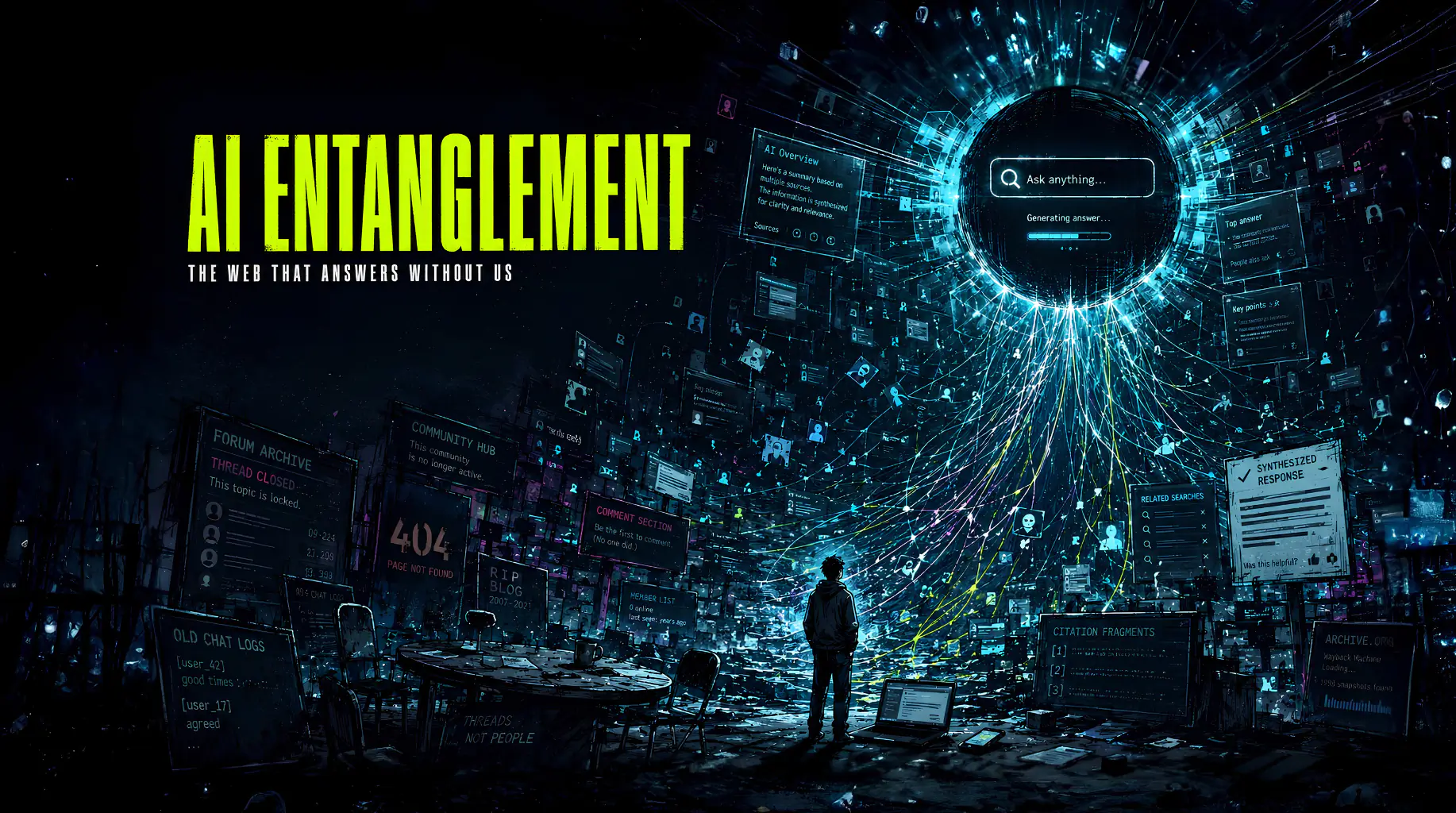
Here the discussion stops being economic and becomes anthropological, because the click that disappears was not just a visit. It was often an entrance into a place where other people had left a trace. The question typed into an engine used to lead, before, to a forum, a discussion, the answer of a stranger who three years earlier had had the same problem. The oracle’s synthesis returns that answer and erases the place it came from.
The company that replaces community
| Indicator | Value |
|---|---|
| Registered Replika users | 30M+ |
| Character.ai users | 20M+ |
| New online articles produced by AI | >50% |
| Stack Overflow participation post-ChatGPT | declining |
Sources: American Psychological Association review on therapy and companionship via LLMs; estimates from the dead-internet debate; research in Communications of the ACM. A four-week randomized controlled trial associates heavy daily chatbot use with greater loneliness and dependence.
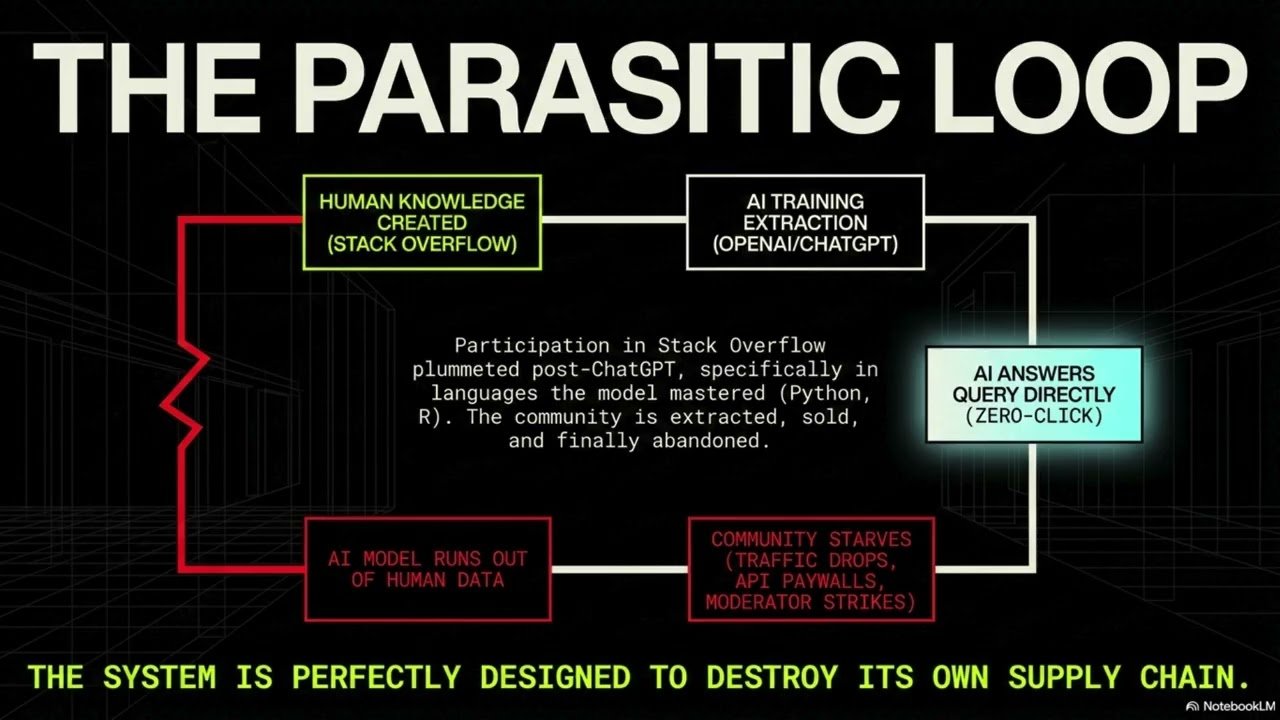
The most measurable example comes from Stack Overflow. The research published in Communications of the ACM documents how participation on the platform fell significantly after the arrival of ChatGPT, with sharper drops precisely in the areas where the model answered best, general purpose languages like Python and R. The mechanism is circular and cruel. ChatGPT was trained on Stack Overflow. It answers in place of Stack Overflow. It empties Stack Overflow. Meanwhile Reddit and other platforms began charging for API access to monetize their users’ contributions as training data, a choice that pushed out contributors and drove moderators to strike.
The community is first extracted, then sold, then abandoned.
There is a daily gesture that captures the loss better than any statistic: the number of people who add the word “reddit” to their searches to find an answer written by a human being. When millions of users manually filter results to dodge synthetic content, they are not optimizing a search. They are looking for the others. They are declaring that something, in the model, has broken. Reddit cofounder Alexis Ohanian has said that much of the internet is now dead, suffocated by bots and by what he called slop, and that many people now find the best information only in private group chats. The square has emptied out and the conversation has retreated into closed rooms.
To name this loss we need tools that come from before the digital. Ferdinand Tönnies, at the end of the nineteenth century, distinguished Gemeinschaft, the community founded on organic, shared bonds, from Gesellschaft, the society founded on impersonal, transactional relationships. The early web, with its forums, was a machine that manufactured Gemeinschaft by accident, putting strangers in contact around a common interest. The oracle is pure Gesellschaft: a transaction between an individual and a system, with no third party, no witnesses, no reciprocity. Ray Oldenburg called third places the informal spaces, neither home nor work, where public life takes shape, the bar, the barbershop, the bookstore. Forums were the third places of the web. The oracle does not replace them with other third places. It makes them useless. And Mark Granovetter had shown that the strength of weak ties, those occasional contacts with people outside one’s circle, is what circulates information, work, opportunity. The forum generated weak ties with every answer. The oracle generates none. It answers and leaves you exactly where it found you, alone.
Building Community While the Architecture Pulls Us Apart
The paradox that gives this section its title is that corporate vocabulary has never talked so much about community as it does now, while the underlying infrastructure methodically removes the material conditions for being together. Communities are launched, community managers are appointed, engagement is measured, and meanwhile the share of the internet generated by human beings thins out. The estimates gathered in the debate over the so-called death of the internet speak of more than half of new online articles produced by artificial intelligence and of a growing portion of network traffic coming from bots. Community is built on top of an architecture designed to bypass one’s neighbor.
The void left by this retreat does not stay empty for long. As third places empty out, the very technology that made them useless offers itself as a substitute for the company it took away. Replika passes thirty million registered users, Character.ai twenty million. A review by the American Psychological Association notes that therapy and companionship have become among the main reasons people use language models. Sherry Turkle described this condition with a phrase that today sounds prophetic, alone together: we expect more and more from technology and less and less from one another. Julia Freeland Fisher, of the Clayton Christensen Institute, proposes an even sharper term for what these artificial companions offer, parasocial capital: the surrogate of a relationship, all the comfort of being heard with no one on the other side, and therefore none of the resources that flow through a real human network.
The data on this surrogate is not reassuring. A four-week randomized controlled trial found that, while some chatbot features modestly reduce loneliness, heavy daily use is associated with greater loneliness, greater dependence and less real-world sociality. The underlying picture is one of a loneliness epidemic already recognized as a public health emergency, to which the solution offered by the market is a conversation that simulates presence without providing it. Robert Putnam, in Bowling Alone, had tied the decline of social capital to the erosion of occasions to meet. His thesis described a society that stopped gathering in clubs and bowling leagues. The 2026 version is a society that stops gathering around a question, because the question finds an answer before it can even become an occasion to meet.
A tension remains that the piece does not resolve, because it does not resolve. If only already-recognized authority survives in the new SERP, and that authority had built itself by producing the content that today fuels the machine’s answers for free, where will the next generation of authoritative voices come from. And if the communities that taught us to be together around a problem empty out in the same movement, while their place is taken by an interlocutor that listens to us without existing, the question is no longer only how to recover organic traffic after AI Overviews. The question is whether we are still learning to be together, or only to seem less alone, each of us in front of our own oracle, which answers, and never asks for anything in return.
- Google — Search Keynote, Google I/O 2026 (Elizabeth Reid)
- SparkToro — Zero-Click Search Study, Similarweb clickstream data 2026
- Ahrefs — AI Overviews & Organic CTR, study on 300,000 keywords, December 2025
- Seer Interactive — AI Overview & CTR Analysis, 5.47M queries, 2026
- Semrush — AI Overviews & Search Intent Segmentation, 2026
- Authoritas — AI Overviews Citation Volatility, 2026
- Communications of the ACM — ChatGPT Impact on Stack Overflow Participation
- American Psychological Association — AI Companions, Therapy & Loneliness
- Reddit — Alexis Ohanian on bots, slop and private group chats
Postscript
Zero-click search is not the beginning of this story. It is the point at which it becomes impossible not to see it. The synthetic answer does not just take a click: it takes the place that click led to, and with it the forum, the discussion, the stranger who three years earlier had solved the same problem. The SERP that closes in on itself is not a product detail: it is a reorganization of how knowledge circulates and of who pays for it.
The question is not whether AI Overviews take traffic. They take it where knowledge is generic and confirm it where the name is already strong, restratifying the web rather than impoverishing it evenly. The real question is who will produce tomorrow’s knowledge, if those who produce it today without a name become a free, uncited source; and whether we are still learning to be together around a question, or only to seem less alone in front of an oracle that answers and never asks for anything in return.