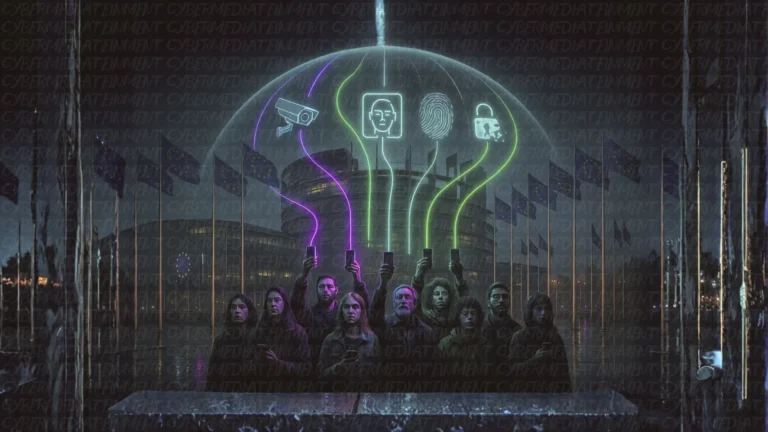


PlayStation Wants Your Face
PSN AND BIOMETRIC ACCESS
Since April 2026, PSN and biometric access have become inseparable: Sony has begun requiring biometric age verification to access chat and communication features on PlayStation Network. Behind the stated goal of protecting minors lies a surveillance architecture managed by a company already sanctioned for GDPR violations, documented by independent researchers as a surveillance infrastructure disguised as an age gate. What happens when the right to play online with friends passes through a scan of your face; and who really holds that data.
In late April 2026, the entanglement between PSN and biometric access became impossible to ignore: hundreds of thousands of players in the UK and Ireland found an unusual message on their PlayStation 5. Complete age verification by June or lose access to messages and voice chat. It is not a security warning against hackers. It is not a system error. It is Sony Interactive Entertainment announcing the start of a new era: that of the identity platform, where playing online with friends first requires proving who you are.
Those who do not complete verification can still play, unlock trophies, and purchase titles on the PlayStation Store. But all communication features (text messaging, voice chat, shared sessions, YouTube and Twitch broadcasts, Discord integration) are deactivated. Starting June 2026, for accounts registered in the UK and Ireland, this will no longer be optional: it will be mandatory. Sony has already signaled that global rollout is a matter of months, not years. The PlayStation Store already reads: “As part of our compliance with global regulations, later this year you will need to verify your age.” Not “UK regulations.” Global.
The question is not whether protecting minors is necessary. It is who collects the data, for how long, under what conditions; and what happens when the system that certifies your identity proves structurally incompatible with European privacy law.
What Is PSN Biometric Access
Biometric access refers to any system that uses unique physical characteristics of an individual (facial geometry, fingerprint, iris pattern) to verify their identity or a demographic attribute. In the context of PSN and biometric access, biometrics are not used to authenticate an already created account: they verify a demographic fact, age. The operating principle is the same (the body as credential), but the function is different. You are not proving you are you. You are proving you are old enough to access certain features of the platform.
This distinction matters for two precise reasons. The first is technical: facial age estimation is a form of probabilistic classification, not identification. The system does not know who you are; it estimates how old you might be, with a margin of error that varies significantly by demographic group, ethnicity, and image quality. The second is legal: biometric data falls within the special categories of personal data under Article 9 of the GDPR, subject to an enhanced protection regime. Any non-compliant processing (excessive retention, undisclosed third-party transmission, invalid consent) is not an ordinary violation. It is an aggravated violation, with proportionally more severe penalties.
How PSN Biometric Access Works
Sony has turned to Yoti, a London-based company founded in 2014 that positions itself as the world’s largest digital identity verification provider: over 800 million verifications completed across more than 200 countries, with clients including Meta, TikTok, OnlyFans, Epic Games, and now PlayStation. PSN and biometric access integrate through three distinct methods. The first is phone number verification: Yoti queries the carrier to confirm the number is associated with an adult. The second is facial biometric scanning (facial age estimation) via selfie: AI technology analyzes facial geometry to estimate age, without requiring a document, but processing images that could potentially qualify as biometric data. The third is uploading an official identity document (passport, ID card, or driving license) matched against a live selfie.
Sony states the process takes “just a few minutes” and only needs to be completed once. Yoti declares that biometric data is deleted immediately after verification, following a “privacy by design” approach certified by international standards including ISO 27001 and SOC 2. In light of what has been documented by independent researchers and a European data protection authority, this reassurance warrants critical scrutiny.
There are laws passed and lawsuits concluded on the promise that these companies have incentives to keep user data private. We found that reality is radically different.
The Academic Dossier on PSN and Biometric Access: Surveillance Disguised as an Age Gate
On May 20, 2026, at the 47th IEEE Symposium on Security and Privacy in San Francisco, a team of researchers from the Georgia Institute of Technology and the University of California, Irvine, presented a study set to cause significant controversy: “Papers Please: A First Look at Age Verification on the Web.” The authors (PhD student Shreyas Minocha, undergraduate Isaac Sheridan, and professors Michael A. Specter and Paul Pearce) conducted an in-depth reverse engineering of Yoti, which according to their analysis covers over 60% of websites requiring age verification.
The findings are precise and concerning. The verification process transmits personal information (including facial photos and device fingerprints) to third and fourth parties external to the user-Yoti relationship: IP geolocation providers, payment processors, and document validation systems. Credit card verification exposes the visited website to the Stripe payment system, revealing the platform on which the check is being performed. Device data collected during verification is specific enough to be used as a device fingerprint to uniquely identify the device over time. Compliance with age verification laws remains surprisingly low: in US states with regulatory requirements, only 13.7% in Georgia and 14.8% in Texas of sites defining themselves as adult content implement an effective verification system. Protection works mainly where it is least needed.
The Spain Case: 950,000 Euros in GDPR Fines
Even more relevant for the European context is what happened in Spain in early 2026. The AEPD (Agencia Española de Protección de Datos) fined Yoti 950,000 euros for a series of GDPR violations that directly undermine the assurances Sony provides its users. According to the Spanish regulator, Yoti had committed unlawful processing of biometric data: generating biometric models from selfies for comparison with identity documents implies a temporary storage phase that Yoti had failed to properly disclose. Geolocation data was retained for five years, well beyond what was necessary. Liveness detection videos for 30 days. Biometric fingerprints for account recovery for a period deemed “disproportionate.” Consent mechanisms were pre-ticked, with wording insufficient to meet GDPR requirements.
The European Parliament formalized the case with a parliamentary question (E-001251/2026), asking the Commission to assess whether Yoti can continue to operate as a vendor for platforms handling data from millions of European citizens. Yoti rejected the AEPD decision and filed an appeal with the Spanish High Court. The case remains open. The direct question is: is Sony entrusting the biometric data of tens of millions of European players to a company under active GDPR judicial proceedings?
The Regulatory Framework That Drove PSN and Biometric Access
Sony’s move did not emerge from nowhere. It is the direct result of a regulatory system that reached a point of no return in 2025. The UK Online Safety Act 2023 entered its most binding phase on July 25, 2025, when child protection obligations for platforms with user-generated content became enforceable. The law, supervised by Ofcom, requires all platforms “likely to be accessed by children” to implement “highly effective” age verification measures. Non-compliant platforms face fines of up to £18 million or 10% of global turnover. Simple self-declaration (the old “I confirm I am over 18”) is no longer sufficient. PlayStation, with its voice chat and user-to-user messaging features, falls squarely within the law’s scope.
On the European front, the Digital Services Act imposes analogous obligations on gaming platforms. Article 28 explicitly prohibits profiling-based advertising toward users identified as minors and requires proportionate measures to prevent their access to inappropriate content. On July 14, 2025, the European Commission published binding guidelines on child protection and a technical blueprint for age verification, based on the specifications of the future EUDI Wallet, the European digital identity wallet expected by end of 2026. The European approach targets a decentralized, cryptographically anonymous system: the user proves they are over 18 without revealing any other personal data. A model diametrically opposed to Yoti’s, which collects documents, selfies, and metadata. The European wallet will arrive. But in the meantime, data from millions of players is traveling far less secure routes.
PSN and Biometric Access: The Gaming Industry Adapts
PlayStation is neither the first nor the only platform. Xbox launched age verification in July 2025, anticipating Sony by about a year with a structurally similar approach: communication features blocked for those who do not verify, games and store accessible to all. Roblox, the platform used by over 151 million daily users (many of them children) took the most drastic step: from January 2026, all users wishing to access chat must complete verification via facial scan or identity document. The decision came after a cascade of lawsuits in the US accusing the platform of creating an environment exploited by predators, with documented cases of grooming, sextortion, and at least one case linked to the suicide of a minor.
Discord had a more troubled journey. In September 2025 it suffered a data breach in which 70,000 user identity document photographs were potentially compromised. The age verification system, launched for the UK and Australia, was suspended globally. Its resumption is expected in the second half of 2026. The pattern is clear: legal and regulatory pressure on one side; reputational crises and security incidents on the other. Platforms are being pushed toward increasingly robust and increasingly pervasive identification systems. The Discord case is also a warning: every age verification system is, by design, a honeypot of sensitive data.
An age verification system is, by design, a honeypot of sensitive data. A breach is not a risk: it is a deferred probability.
The Paradox of Protection: Safer, Less Anonymous
Gaming platforms have represented for decades a space of social pseudonymity: one built a parallel identity, interacted with strangers in ways that would have been impossible in real life, experimented without consequences. This characteristic had dark sides (cyberbullying, grooming, exposure to inappropriate content), but also positive ones: inclusion of people with social difficulties, identity experimentation for LGBTQ+ teenagers, community building. Age verification is not a neutral tool with respect to this history.
On a technical level, it ties a verified physical identity to a digital profile containing years of behavioral data, gaming preferences, consumption habits, and social interactions. The profile ceases to be pseudonymous and becomes de facto identifiable. On the European regulatory level, the EDPB clarified in its February 2025 statement that protecting minors “does not justify disproportionate or excessively invasive solutions” and that any age assurance system must respect the data minimization principle. The Yoti model (as demonstrated by the Spanish fine) risks being structurally in conflict with this principle. The technically correct solution exists: it is zero-knowledge proof, a cryptographic system that allows proving an attribute without revealing any underlying data. It is precisely the approach the European Commission is working on with the EUDI wallet. But the wallet will be operational, at best, by end of 2026. In the meantime, billions of verifications are being performed with systems that collect far more than needed.
The questions every European player and every parent should be asking are precise. Who holds the biometric data (Sony or Yoti) and for how long? What happens if verification is refused: is the right to play online in communication mode contingent on surrendering sensitive data, and is this consistent with the GDPR principle of freedom of consent? What is the response plan in the event of a breach similar to Discord’s? And is the system truly effective, if it protects minors only on major platforms while leaving them exposed on smaller ones, where compliance according to the Georgia Tech–UC Irvine study does not exceed 15%?
- Sony Interactive Entertainment — PSN Age Verification FAQ UK (playstation.com)
- Biometric Update — Age Verification Expands in Gaming: Minecraft Selects Yoti, Discord Tests Persona, January 2026
- Georgia Tech / UC Irvine — “Papers Please: A First Look at Age Verification on the Web”, IEEE SP 2026, San Francisco, May 20, 2026
- AEPD — Yoti 950,000 euro fine for GDPR violations, February–March 2026
- European Parliament — Parliamentary Question E-001251/2026 on Yoti and GDPR compliance
- UK Online Safety Act 2023 (legislation.gov.uk)
- European Commission — DSA Art. 28 Guidelines: Protection of Minors, July 14, 2025
- EDPB — Statement on Age Verification Systems, February 2025
- VGC — PlayStation Has Started Telling UK and Ireland Players to Verify Their Age, April 21, 2026
- Roblox Newsroom — Roblox Requires Age Checks for Communication, November 2025
- European Commission — eIDAS 2.0 / European Digital Identity Wallet (EUDI)
PSN and Biometric Access
Age verification on PlayStation is not the beginning of this story. It is the point at which the story becomes impossible to ignore for those who play. Biometric identification infrastructure is already embedded in the gaming ecosystem (Xbox, Roblox, Discord, soon Sony) and its expansion occurs by degrees, in contexts that appear technical but carry precise civil consequences. The stated goal of protecting minors is legitimate and urgent. Statistics on online risks for children are devastating. But how a solution is built matters as much as the solution itself.
A system that collects biometric data in quantities exceeding what is necessary, forwards it to unidentified third parties, is managed by a company under open GDPR judicial proceedings in a European country, and according to independent research functions as a surveillance infrastructure: this is not necessarily the right way. The European Commission has indicated a different path; decentralized, cryptographically secure verification, built on European digital identity. It will come. But it will take time. And in the meantime, data from millions of European players is already traveling far less secure routes.