
The Price of Attention
Attention Economy · Platforms · Neuroscience · Digital Rights · June 2026
The most used apps in the world do not charge you, and the reason is uncomfortable. The product is you, or rather, it is your attention. A walk through the attention economy, the finite resource platforms extract and resell, from the mechanisms that capture it in the brain to the question no law has yet dared to ask. This is the price of attention. Is there a right not to look?
You unlock it without noticing. Your thumb finds the icon before you have decided to open it, your finger scrolls before you know what you are looking for. Three minutes pass, maybe ten. When you look up you cannot remember why you picked up the phone, and you will pick it up again soon without remembering this time either.
It happens to everyone, dozens of times a day. It looks like a personal weakness, a matter of willpower. It is not. That gesture is the finished product of an industry that has worked for years to produce it, and that builds its revenue on exactly that gesture.
What Is the Attention Economy
In 1971, in an essay on how organizations should be designed, the economist Herbert Simon put his finger on an idea that felt abstract then and is our daily life now. In a world rich with information, he wrote, information consumes something that grows scarce in proportion to its abundance: the attention of the people receiving it. The more there is to look at, the less of the capacity to look remains.
This is where the phrase attention economy comes from. It describes a system in which human attention is treated as a commodity, a limited resource that can be measured, fought over, bought and sold. The raw material here is not oil and it is not data, it is the time your eyes stay on a screen.
That reversal is still the key to reading the present. What we needed were systems that could protect us from the flood of information. Half a century on, we have built ones that are very good at producing the flood, and at keeping us inside it.
What they call engagement is just the technical name for a habit you never chose.
Why Social Media Is Free
When a service does not charge you, the product is usually not the service. It is you.
The model is almost two centuries old. The cheap newspapers of the nineteenth century invented it, selling the copy below cost and making their money by reselling readers’ attention to advertisers. The paper was the bait, the reader was the goods, the advertiser was the real customer. The medium has changed, the mechanism has not. Today platforms give away messaging, video and photos, and in return they package your attention into lots to sell to whoever buys the ad space.
This is why free is a misleading word. What you do not pay in money you pay in hours, and hours do not come back the way money does.
Then there is the reason you do not leave even when you want to. No one forces you to stay on a platform. But when your friends, your contacts, sometimes your work are all inside it, leaving stops looking like a choice and starts looking like a loss. The freedom to walk away exists on paper, and on paper it tends to stay.
How Platforms Capture Your Attention
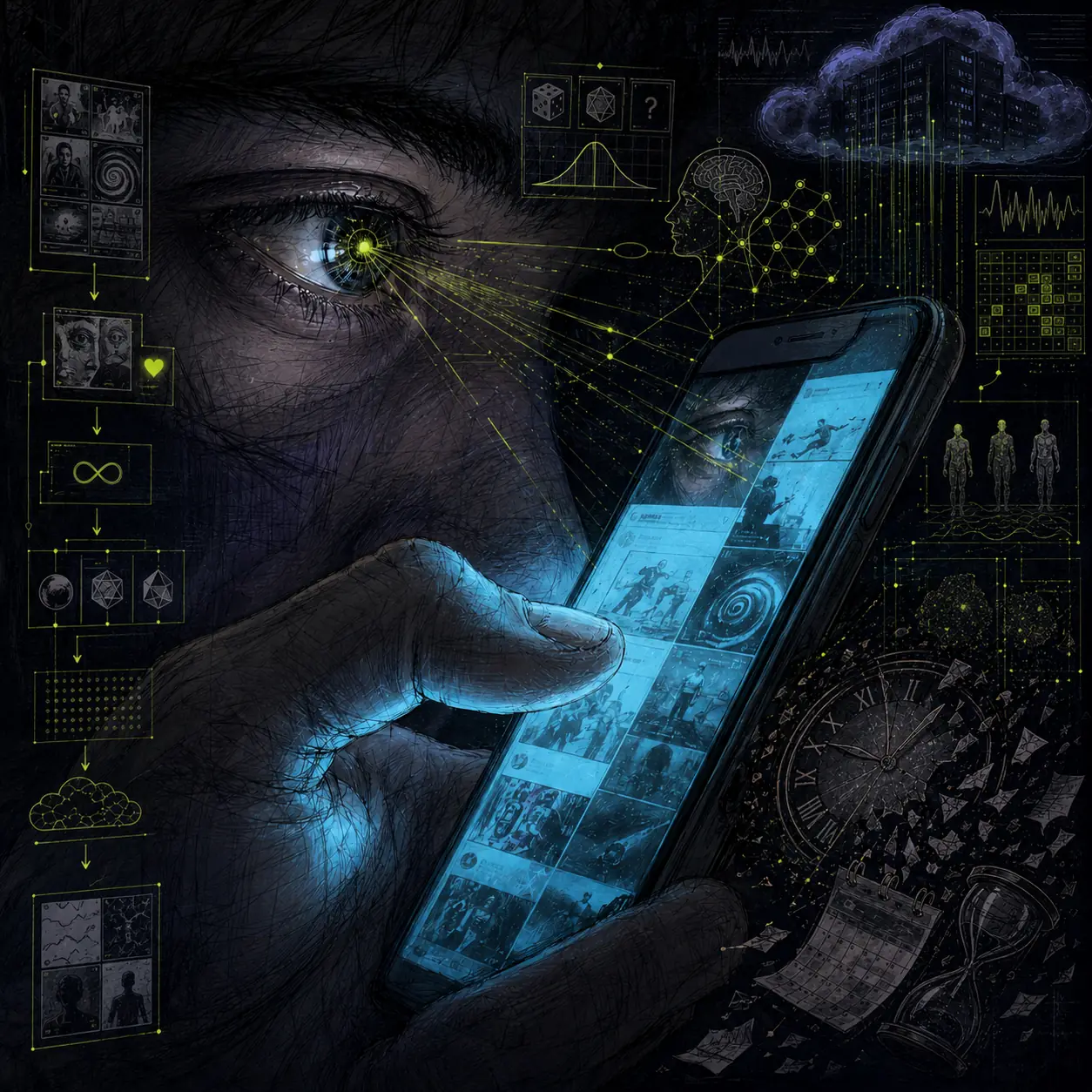
The capture starts from a mechanism the brain already had, one platforms have simply learned to press. It is called salience, the way the mind flags, among a thousand stimuli, the one that deserves attention right now. A notification, a vibration, even the bare time since the last check switch this signal on and mark the phone as urgent.
Underneath runs dopamine, the neurotransmitter that governs the anticipation of a reward more than the reward itself. This is where the most effective trick sits. The strongest hit does not arrive when you get the like, it arrives in the uncertainty before it, in not knowing whether this time there will be one. It is the logic of the slot machine, and it has a technical name, the variable ratio: rewards handed out at unpredictable intervals, which keep the mind in a constant state of anticipation.
Everything else is built on this principle. Infinite scroll removes the natural points where you would stop. Autoplay starts on its own before you decide. Notifications arrive measured out. There is even a manual, famous in Silicon Valley, that codified the sequence into four moves: trigger, action, variable reward, investment. The people who design these interfaces know exactly what they are doing. A former Google designer spent years denouncing it from the inside; a whistleblower who left Meta produced documents in which the company had understood that the most divisive content was also the content that held people longest, and pushed it anyway.
One clarification, because public debate tends to overshoot here. Talking about addiction as if it were a drug is imprecise, and it inflates the phenomenon instead of explaining it. The mechanism of salience and variable reward is real and documented; the clinical label of addiction, stuck onto anyone who scrolls too much, is something else. Precision matters more than alarm.
The Price of Attention, in Numbers
The figures need one caution, because the ways of measuring them do not agree. Surveys where people estimate their own use give different results from data collected straight off the device. The orders of magnitude, though, line up, and they are enough to frame the phenomenon.
At the start of 2025 the average user spent around two hours and twenty minutes a day on social media. Screen time as a whole weighs far more, around six and three quarter hours a day worldwide, with the United States close to seven and the youngest generation steadily above nine. The average American checks the phone almost a hundred times a day.
One projection makes the point better than any average. At six and three quarter hours a day, from age ten to seventy-eight, you reach roughly nineteen years of life spent in front of a screen. For those born inside this era the estimate nears thirty. That is the price the title is talking about, measured in the only currency that really counts.
The Real Price of Attention
So far we have been talking about time. But the deepest damage is not measured in hours, and to see it you have to move your gaze from the clock to the mind.
A hard word for it had been coined by the philosopher Bernard Stiegler: proletarianization. With the industrial revolution the worker stopped knowing how to make by hand what the machine made in his place, and in exchange for a wage he lost a skill. Something similar happens now with attention: by handing platforms the choice of what to look at, we unlearn how to choose it. He had a name too for this direct grip on attention and desire by those who sell: psychopower.
To grasp what is being lost you need the opposite idea. It was placed at the center of everything by Simone Weil, who described attention as a patient availability, a making of room inside oneself for what presents itself. Nothing to do with the effort of grabbing; closer to the calm of receiving. It is the exact reverse of the scroll, which receives nothing and consumes everything at a steady speed.
This is not a new battle. Attention has been contested ground since there has been an industry interested in steering it, from mass advertising onward. What differs is the scale, and the precision. Never before was the capture so tailored, person by person, second by second.
Attention is the last common ground left, and they are fencing it in.
The Right Not to Look
From here comes a claim public debate has only just begun to phrase, and almost always in its weaker form. People talk about a right not to be disturbed, about being able to switch off notifications, about getting a weekly summary of time spent. Useful things, all of them passive: they ask the platform to grant you a break.
There is a stronger version, and a more uncomfortable one for the people who design these interfaces. It concerns the capacity to look away on your own, without waiting for the system to allow it. An attention that goes back to being a faculty you exercise, rather than a surface to be fought over. Seen this way, not looking stops being a renunciation and becomes an act. The same active openness described a moment ago can become an openness refused on purpose, withheld from the market that demands it.
Someone has already put it in political terms. We need a freedom of attention comparable to freedom of speech. And like any freedom, it holds only if it includes its opposite: the permission to close, to not answer, to look elsewhere.
What the Digital Fairness Act Changes
The institutions are moving, with their usual delay. In December 2023 the European Parliament passed a resolution against addictive design, taking explicit aim at infinite scroll, autoplay and recommendations built to maximize time on the app. That is where the idea of a right not to be disturbed first appeared in an official document.
The follow-up is called the Digital Fairness Act. The public consultation closed in the autumn of 2025 and the European Commission is due to present its proposal by the end of 2026. The stated aim is to update consumer protection for the age of interfaces that manipulate, from dark patterns to aggressive personalization.
The familiar gap remains. The infrastructure that captures attention is already running, refined, everywhere; the rule meant to limit it is still a draft in consultation. By the time it arrives, it will find a habit already installed in billions of people. A law can require a button to switch off autoplay. What it cannot do is give back the faculty we will have unlearned in the meantime.
- Herbert A. Simon — Designing Organizations for an Information-Rich World, 1971
- Statista / We Are Social, DataReportal, Hootsuite — Average daily social media use, February 2025
- DataReportal — Digital 2025 Global Overview Report
- European Parliament — Resolution on addictive design of online services, 12 December 2023
- European Parliament, Legislative Observatory — Resolution summary and the digital right not to be disturbed
- European Parliament — Digital Fairness Act, Legislative Train Schedule
- Harvard SITN — Dopamine, Smartphones and You: A Battle for Your Time
- Simone Weil — Reflections on the Right Use of School Studies, in Waiting for God (1951)
- Bernard Stiegler — Taking Care of Youth and the Generations (2010)
Post scriptum
The attention economy is not a metaphor. It is a precise market, with a raw material, involuntary suppliers and buyers. The raw material is you while you look. Understanding the mechanism does not switch off the phone, but it changes who holds the switch.
One simple question is worth keeping open. If attention is the last thing truly ours that we have left to give, why should we accept that it be taken by default? The right not to look starts here, with naming it.