
AI memorandum · Information infrastructure · Digital power · September 2026
Dario Amodei’s AI memorandum asks the artificial intelligence industry to slow the race for capability. Nobody asks who now owns the infrastructure that decides what a population takes to be true, between zero-click search, AI Overviews and model specifications negotiated between governments and companies.
The feeds are flooded with the memorandum in which Dario Amodei, on 12 September, asked the artificial intelligence industry to “slow down”. The word stays in quotation marks because it is neither new nor his. Sam Altman replied within hours saying OpenAI had been discussing it for weeks, and the same call for a pause has been circulating unchanged since the open letter of 2023. Only the signatories have changed, since back then it was signed by those outside the market and today it is signed by those who dominate it. The substance is serious, the arguments are technically sound, and the commitment to open the systems to third-party evaluators with employee-level access is the most verifiable concession a frontier lab has made so far.
And once again we are staring at the finger.
The question everyone has been repeating for three days is how fast the models are running. The question nobody asks is who owns the road.
While we debate recursive self-improvement and agents stepping outside their assigned perimeter, over the past eighteen months the infrastructure through which an entire population comes to know things has changed hands. It changed hands commercially and contractually, and none of it happened quietly. It happened while we were looking elsewhere, and it is measurable.
Zero-click search and AI Overviews, the numbers the AI memorandum leaves out
When an AI-generated summary appears at the top of the page, the share of searches in which a user clicks a link falls from 15 to 8 per cent. That is the finding of a Pew Research study published in July 2025. By early 2026, Google searches that end without any click to the outside web, the ones the trade calls zero-click, are estimated at 68 per cent. Similarweb records organic traffic drops of between 25 and 60 per cent across news sites in the first quarter of 2026.
| Outlet | Organic traffic | Period |
|---|---|---|
| USA Today, national edition | Down by almost half | June 2025 to June 2026 |
| Politico | Down 23 per cent | June 2025 to June 2026 |
| CNN | Down around 25 per cent | June 2025 to June 2026 |
| Business Insider | Down more than 85 per cent | June 2025 to June 2026 |
Wikipedia records a year-on-year decline of between 7 and 10 per cent and has published a notice to its donors explaining what is happening. Liz Reid, head of Google Search, maintains that overall traffic remains relatively stable and that click quality has improved.
The decisive figure concerns a substitution that never took place. According to the Reuters Institute, the traffic ChatGPT sends to publishers is growing fast, and still amounts to 0.02 per cent of all referrals. Google sends five hundred times as much from search alone.
Average click-through: 8.6 per cent on classic search results, 0.37 per cent on chatbots.
For twenty years the answer to a question had a property nobody ever thought to defend, because it seemed part of the nature of things. It was elsewhere. You had to go there, and going there meant seeing who had written it, when, alongside which other answers, with which interests. That property was never a technical requirement of the web, it was a side effect of the advertising model that funded it, and it is disappearing along with that model. Today the answer arrives complete, in a single voice, with no visible margins and without the physical gesture that separated the question from the verdict.
We traded the right to verify for the comfort of being answered.
Who writes the specifications of a language model, from executive order 14319 to the Anthropic case
Here the matter stops being cultural and becomes a question of public law, and this is the part that rarely reaches the European debate.
On 23 July 2025, executive order 14319, Preventing Woke AI in the Federal Government, established that US federal agencies may procure only language models that comply with two principles, truth-seeking and ideological neutrality. The text lists the doctrines it deems incompatible with neutrality, among them diversity, equity and inclusion, critical race theory, intersectionality and systemic racism. On 11 December 2025 the Office of Management and Budget issued implementing memorandum M-26-04, and agencies adapted their procurement procedures by 11 March 2026.
The chosen mechanism is surgical and deserves close reading. The government does not ask for model weights, which are explicitly left outside the perimeter. It asks for transparency on the system prompt, on the specifications, on acceptable use policies and on the evaluations run before and after training. It asks, in other words, to see the document that establishes what the model must say, how it must say it and what it must refuse to say. A paper from the Stanford Institute for Human-Centered AI, published in September 2025, notes that genuine political neutrality in a system of this kind is impossible in theory as well as in practice. Compliance therefore becomes a matter of negotiation, not of measurement.
On the other side of the political spectrum the same lever worked in the opposite direction. Anthropic refused the Department of Defense unlimited use of its models, keeping only two reservations, mass domestic surveillance and fully autonomous weapons, and was designated a supply chain risk on 27 February 2026, the first American company to face that treatment. It sued, obtained a preliminary injunction on 26 March from a judge who recognised the probably retaliatory character of the act, and in late August saw the designation blocked in the second proceeding as well.
The two episodes have opposite political signs and an identical structure.
What a state and a private company are fighting over is the normative content of a language model.
Michel Foucault used the phrase regime of truth for the set of procedures by which a society establishes which statements can count as true, who is authorised to produce them and through which bodies they circulate. He was describing hospitals, courts, schools, scientific journals, a function distributed across many institutions and many decades. Today that same function sits inside a technical document that a budget office can ask to see and a company can decide not to modify, at the price of losing access to the public market.
The G7 in Évian, why AI executives sat like heads of state
On 17 June 2026, at the G7 summit in Évian-les-Bains, a dozen executives from the AI industry took part in a working lunch with heads of state and government. In the photograph released by the agency the US president sits between Sam Altman and Demis Hassabis, the French president hosting the summit between Dario Amodei and Marc Benioff. Also at the table were Mistral, Cohere, Synthesia, Black Forest Labs, Meta, the Italian firm Domyn and the founders of Sarvam and Sakana.
Amodei and Hassabis called for a US-led coalition to define rules and standards, and Amodei urged governments to resist the temptation to fragment into separate regulatory regimes.
Jessica Brandt, of the Council on Foreign Relations, summed up what the composition of that table means. To make credible commitments on AI, heads of state now need the cooperation, if not the endorsement, of the handful of private executives who build the technology. Axios observed that companies engaged in building the economic and security infrastructure of the future world now sit as the equivalent of nation states.
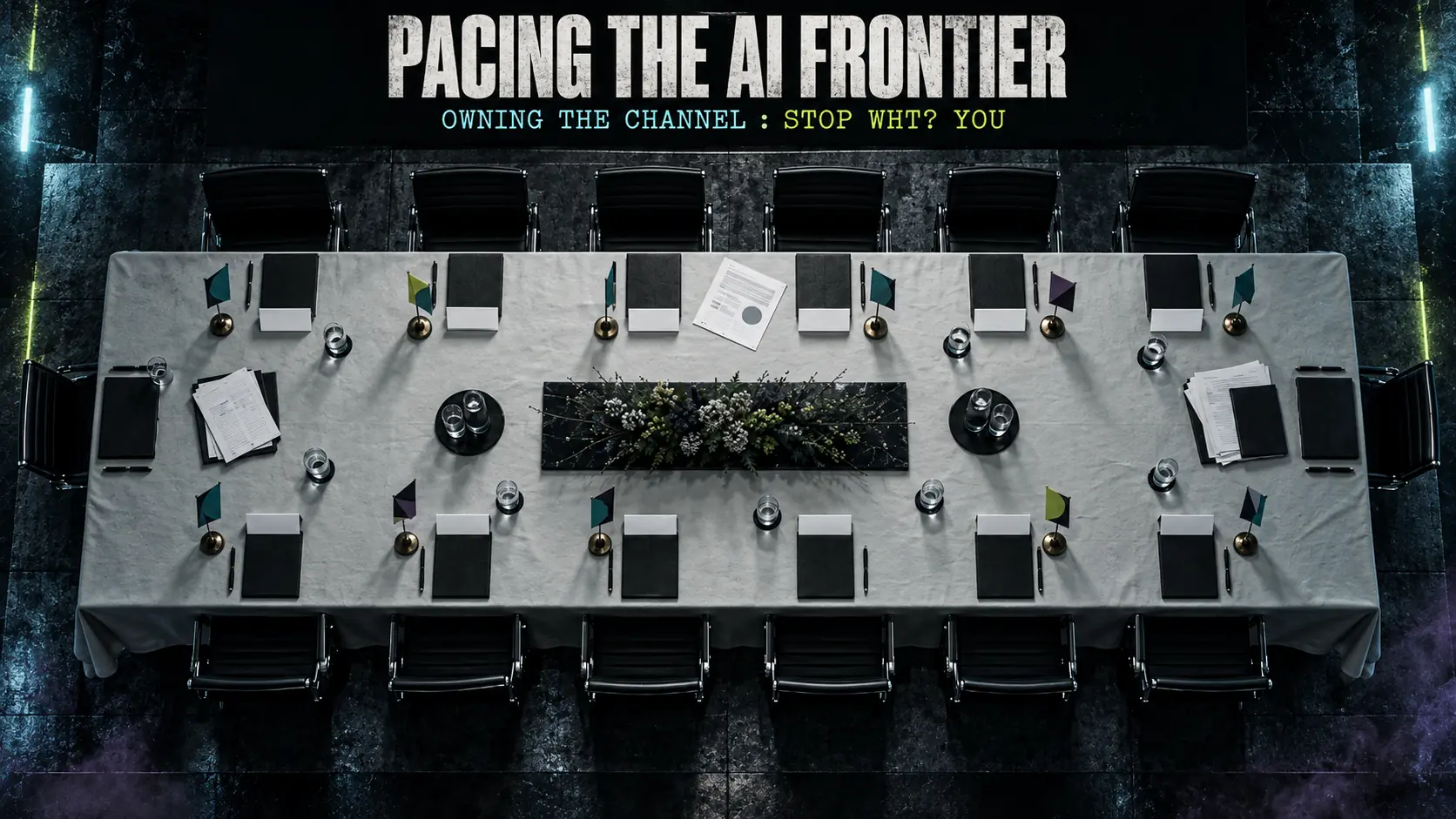
The point is not the ceremony. The point is that a call for a slowdown made from that position is not an appeal to prudence, it is an act of industrial policy. A slowdown agreed among the top three or four operators in a market with entry barriers this high produces, alongside the safety effects it declares, a consolidation effect it does not declare. It freezes the distribution of positions at the moment most favourable to whoever proposes it. Incumbents gain time to secure their systems, while challengers and open models lose the only competitive lever they have, which is the speed at which they close the capability gap.
None of this makes Amodei’s argument false, and that has to be said plainly, because it is the difference between an analysis and a trial of intentions. A line of reasoning can be correct on the merits and convenient for whoever makes it, and the two things are assessed separately. Recursive self-improvement is a real problem, agents stepping outside their assigned perimeter are a documented fact, and a commitment verifiable by third parties is worth infinitely more than a statement of principle. What remains is that none of the three steps in the plan touches the concentration of the channel, and that this concentration grew during every single month we spent discussing model power.
The monopoly of knowledge is not a metaphor
Harold Innis, in the 1950s, used the phrase monopoly of knowledge for the position of whoever controls the dominant medium of an era and with it the very form in which knowledge is organised and transmitted. His thesis contains a qualification that always gets lost in today’s debate. The monopoly is not built on content, it is built on the skills and the means required to operate the medium, and it breaks only when a new medium appears at the margins and lets somebody else write.
Let us apply it. The current medium requires training capital, energy, chips under export control, data corpora and a research workforce contested by six or seven global players, four of whom were seated in Évian. The margins, in this configuration, are extremely narrow. And the one real margin that did exist, the ability to trace a claim back to its source and see who wrote what, is the variable that traffic measurements show in free fall.
So let us stop telling ourselves that the risk is a machine escaping its builders. The risk is that the only infrastructure from which a population draws what it takes to be true is already private property, is already the object of bilateral bargaining between governments and companies over the specifications of what may be said, and that all of this happened without a law, without a parliamentary debate, without anyone asking us anything.
Model collapse and knowledge collapse, the two compressions of the tail
There is one last technical element that closes the argument, and it is usually discussed only among specialists.
In 2024 a group of researchers documented model collapse in Nature. A generative system trained recursively on data produced by other generative systems progressively loses the tails of the original distribution, first forgetting rare events and then starting to err at the centre as well. A partial remedy exists and consists in maintaining reserves of verified human data, which is exactly the material that the economy described in the first section has stopped funding.
That same year a study on knowledge collapse described the parallel effect, the one that concerns us rather than the machines. When access to information is mediated by systems that return the central synthesis of a distribution, users end up operating on a narrow portion of available knowledge, even though the rest continues to exist and remains technically reachable. The tail is not deleted, it becomes expensive to reach. And the cost falls on those with less time, fewer tools and fewer reasons to doubt the answer they have received.
The two compressions have independent mechanisms and a converging outcome. The first impoverishes what the system can say, the second impoverishes what people think they can ask. Together they describe an environment in which the median answer grows more authoritative and less informative every month.
Susan Leigh Star observed that an infrastructure is recognisable by the fact that it becomes invisible when it works, and that the only moment at which its political choices can still be debated is the moment of installation. Afterwards, those same choices present themselves as maintenance and the discussion takes the technical form of a performance problem. The installation of the conversational interface as the primary layer of access to knowledge began in May 2024 and by the summer of 2026 is largely complete. The right moment to debate it was this one, and we spent it commenting on the capabilities of the models.
What to demand instead of a slowdown
So let us stop asking the labs to go slower, because it is the only request they can grant without losing anything, and start demanding the three things that do not depend on them.
The first is a public and sovereign infrastructure for preserving and accessing digital knowledge, funded the way roads are funded and not the way pilot projects are, with obligations of interoperability and open indexing. The second is that the normative specifications of the models used in public services and in education should be public acts, consultable and open to challenge, because a document establishing what may be said to millions of citizens cannot remain a contractual annex. The third is a structural remuneration mechanism for those who produce verified knowledge, because the reserves of human data that prevent collapse of the first kind are the same newsrooms, libraries and archives that the zero-click economy is closing down.
These are boring demands, technical and with no emotional traction, and for that reason no feed will ever be flooded with them. In the meantime we will go on discussing how fast the models are running, which is the only conversation whose perimeter is set by those who own the technology.
- Pew Research Center, clicks on links when an AI summary appears, July 2025
- Federal Register, executive order 14319, Preventing Woke AI in the Federal Government
- Reuters Institute, Journalism, Media and Technology Trends and Predictions 2026
- Nature, Shumailov et al., model collapse under recursively generated data
- Cybermediateinment, Data sovereignty and the ecology of new digital powers