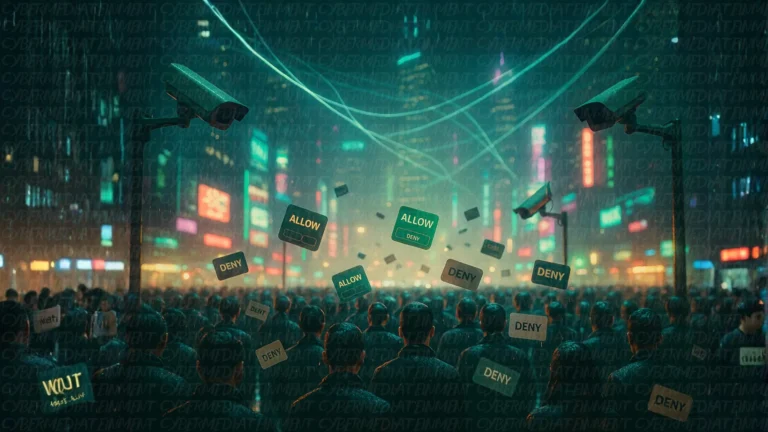


Two People, Two Worlds
Social Bubbles and Algorithms · Digital Polarization
Two phones on the same table, two opposite feeds staring back. The filter bubble promises isolation, but the real force at work underneath is what keeps us glued to the same fight, in the same arena, with no way out.
The filter bubble, the idea that social media isolates each of us in our own custom reality, doesn’t hold up to data. Two people can watch the same rally on different phones, and each sees a crowd of opposite comments underneath the video: yet neither is isolated, because each spends the day inside the other’s feed, watching it rather than ignoring it.
The term, coined by Eli Pariser in 2011, describes a phenomenon the research struggles to confirm. Andrew Guess tracked the real browsing habits of thousands of people and found information diets that were more varied, not narrower, than those of someone who once bought a single partisan newspaper and read nothing else. The Reuters Institute review that collects this research notes that the bubble and the echo chamber circulate in public discourse far more than the evidence supports, and that even scholars can’t agree on what the terms mean.
A finding by Petter Törnberg pushes the question further. In his models, a handful of rules about how ties between people form and break is enough to produce closed, hostile groups within the network, and these groups form even without a filtering algorithm and without individuals actively seeking out people like themselves. Closure isn’t a wall between separate spaces: it’s something that happens inside a single space, when that space is crowded and tense enough.
That leaves a question the reassuring version of the bubble avoids. If we aren’t isolated, if we see each other more than ever, why are we so divided?
Whoever has actually measured how people browse has found information diets that are more varied, not narrower, than those of someone who read a single partisan newspaper.
The Spiral of Social Bubbles
A single online exchange can grow into hundreds of replies through a precise mechanism: a mild reply draws no attention, a vicious one gets quoted, shared, and pushed in front of thousands of people who would never have seen it otherwise. Each round makes the next one sharper, because the platform has learned that sharpness holds attention while agreement lets it go.
The mechanism has a precise name, coined in the 1940s by researchers studying thermostats and anti-aircraft targeting systems. Norbert Wiener called it positive feedback, distinguishing it from negative feedback, which stabilizes, like a thermostat that shuts off the boiler once the room is warm. Positive feedback takes a deviation and amplifies it: it’s the same principle behind the screech that happens when a microphone gets too close to the speaker carrying its own sound.
The more their content diverges, the more they have to share the channel that lets them diverge.
The screech, though, doesn’t isolate anyone: it’s a sound everyone in the room hears together, at the same frequency. The same holds for the spiral of an argument. To keep escalating with each round, both sides have to stay locked to the same circuit, hear the same stimulus at the same instant, respond in real time. The force that seems to pull them apart is the same one that keeps them nailed to the same spot.
Republicans paid to listen to a month of Democratic voices came out more conservative. Democrats, slightly more left-leaning.
Christopher Bail confirmed this with an experiment designed to produce the opposite result. He paid American voters to spend a month listening to the other side, betting on the old idea that getting to know the enemy up close makes them less of an enemy. The opposite happened: Republicans came out more conservative, Democrats slightly more left-leaning. Other researchers, like Guess and Coppock, didn’t find the same backlash in similar experiments, and the safest explanation is that it happens only under certain conditions. But even the possibility is enough to replace the image of two solitudes drifting apart with that of a single downward spiral both sides fall into together.
The reason the same intensity ignites opposing sides is as old as the species. For a hundred thousand years, recognizing one’s own and sensing the outsider was a matter of survival, and group instinct responds to signals of us and them before any thought forms. How manipulable that instinct is was shown by ethologist Nikolaas Tinbergen: gull chicks peck at a stick with a red spot bigger and brighter than their real parent’s beak with more force than they peck the real thing, because instinct doesn’t look at the whole object, it locks onto a simple signal and reads it with a crude rule, the stronger the signal, the more it counts. The platform works like that rigged stick: it offers an us more tightly knit than the real one and a them more monstrous than the real one, and faced with that oversized lure the reaction doesn’t vary, it converges, because it’s the same ancient response firing in anyone, whatever the flag.
Digital Conformity
Journalist Kyle Chayka traced the same dynamic outside the realm of opinion, in interior design. Traveling, he noticed that independent cafés in cities worlds apart, Tokyo, Berlin, Cape Town, all looked alike: white tile, raw wood, exposed bulbs, avocado toast. The mechanism is the same as the spiral: a venue that photographs well gets photographed more, the photos get rewarded and spread, other owners copy what works, and with each round the aesthetic best at generating engagement crowds out the rest. Chayka calls the result Filterworld: a thousand niches that look different, all sliding toward the same average center.
Filterworld: a thousand niches that look different, all slid toward the same average center.
The most obvious objection is that a flat mainstream culture has existed in every era, and that Chayka mistakes something old for something new. It holds up, but applied to opinions his observation still works: factions multiply, values fragment, and the way of stating them narrows into a single format, a curve that always starts with outrage and, within hours, runs from news to mockery to mobilization. Anyone active in one camp moves with the same gestures as anyone active in all the others.
Factions multiply, values fragment. The way of stating them narrows into a single format.
It’s Törnberg’s finding seen from another angle: uniformity doesn’t need anyone to impose it from above, it emerges on its own from the shared shape we all move within.
Beneath the Social Bubbles
If the two people at the table don’t share opinions, what do they actually share? A first answer was written by philosopher Jean Baudrillard decades before there was a feed: the relationship between signs and reality has reversed, and today the model comes first, produces what it’s supposed to describe, until the territory evaporates and only the map remains. He called this condition hyperreality, where simulation becomes more solid than the real thing. The two screens don’t show two pieces of the same world seen from opposite sides: they show two edits of the same simulation, over a territory that has already vanished for both in the same way.
Hyperreality: the model comes first, produces what it’s supposed to describe, and the territory evaporates.
Philosopher Maurice Merleau-Ponty adds a deeper layer. Perceiving, for him, doesn’t mean receiving a ready-made world behind glass, but constituting it in the encounter between body and things, in an interweaving he called flesh: the world feels real and shared because other bodies, alongside ours, perceive the same world, and it’s they who guarantee we aren’t dreaming alone. Replace that flesh with the feed, and for most of our waking hours, scrolling a screen becomes the way the outside world becomes experience. The stakes are no longer which opinions we hold, but through which organ the world reaches us before an opinion even forms, and that organ, for whoever is looking from the first phone and whoever is looking from the second, is now the same one.
Törnberg’s thread returns here: closure was a property of shared space, and now we see how far that space reaches. It isn’t just the platform, it’s the evaporated territory Baudrillard described and the unified flesh Merleau-Ponty described. We now share almost everything, except opinions, which remain the one thing we hold up in front of our eyes.
| Researcher | Finding | Implication |
|---|---|---|
| Andrew Guess | More varied information diets, not narrower ones | The bubble doesn’t isolate the way it’s assumed to |
| Christopher Bail | Exposure to the other side hardens positions | Contact doesn’t moderate, sometimes it radicalizes |
| Nikolaas Tinbergen | An exaggerated signal beats the real one in gulls | Polarizing content exploits the same instinct |
| Petter Törnberg | Closed groups emerge even without a filtering algorithm | Closure comes from shared space, not isolation |
| Kyle Chayka | Niches all converge toward the same Filterworld | Uniformity is an effect, not an imposition |
Gravity: The Pull of Social Bubbles
The reassuring version of division is drift: two continents breaking apart and losing sight of each other in the ocean, an image that leaves two lands intact, however distant. The data tell the opposite story: not drift but a fall toward a single center, the spiral that keeps everyone on the same circuit, the ancient lure that fires the same reaction in everyone, the single mold beneath ever more divergent opinions, the vanished territory and the flesh that has become one. What we mistake for two worlds repelling each other is the surface of a gravity pulling all of us toward the same point: the arena, the last place we still find ourselves, truly, all together.
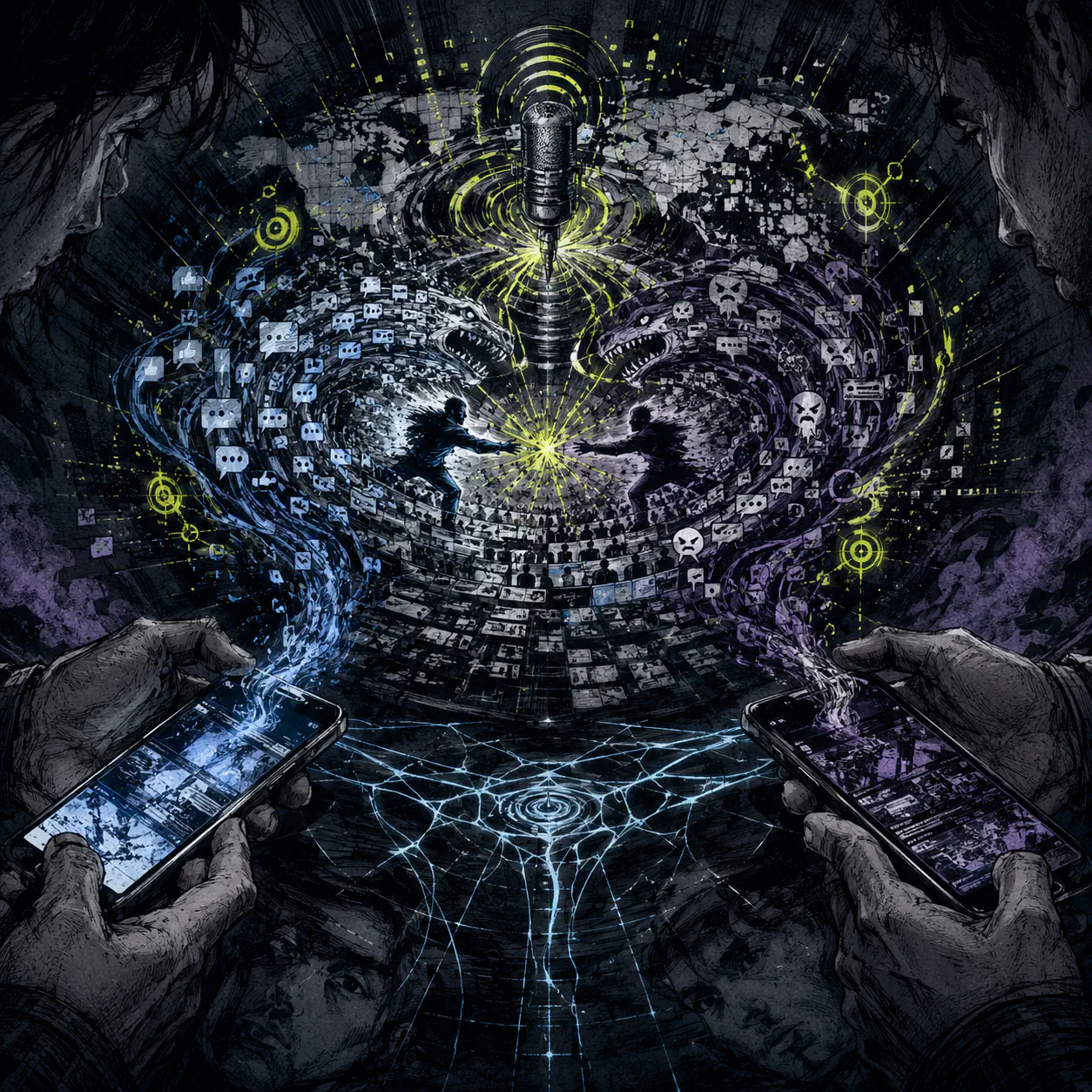
If the only space we still hold in common is an arena, and an arena exists only as long as there’s a fight in it, then peace would carry a cost almost no one accounts for: it would also mean the end of the last shared ground we still divide. Maybe we clash so fiercely because the clash is the last thing we still do together, the only instant the two people at the table actually touch.
They believe they live in two worlds. They live in only one, and they don’t notice, because the only time they touch is to strike each other.
Postscript
If this piece left you with the feeling of being watched while you watch the screen, that’s not a wrong impression. The flesh Merleau-Ponty describes is also the place where platforms measure every breath you take, every pause, every return to the same content.
The video below tries to show how the spiral of conflict actually works, step by step, from the first sharp comment to the scroll that swells on its own.