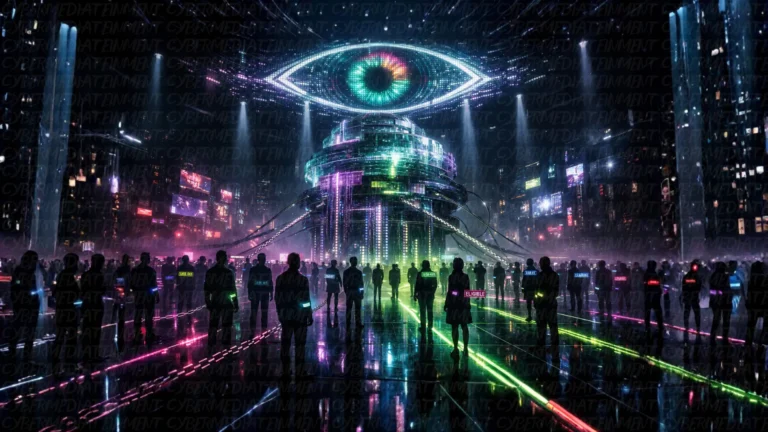
What Is AGI, Really? A Body Beyond “Intelligence”
TL;DR: AGI isn’t a single brain or a magic algorithm. It’s a distributed system emerging from data, bodies, tools, and environments: hardware (body), software (nervous system), and networks (habitat). AGI is a threshold we’re already crossing.
AGI: why one definition of intelligence isn’t enough
Intelligence isn’t just “making predictions” or “speaking well.” It’s associating ideas, learning from mistakes, and adapting to context. Seeking a single definition is misleading: intelligence is emergent and situated—it depends on how a system is built and where it lives.
Turing shifts focus from essence to behavior: the Imitation Game evaluates what a machine does. With morphogenesis he shows how complex structures can arise from simple rules. Shannon frames information as uncertainty reduction: hence coherence (keeping meaning across steps) and cognitive energy (the human or computational effort to do so against noise). Minsky describes mind as a “society” of agents—no single center, but modules that cooperate and compete.
The Embodied Mind (Varela, Thompson, Rosch) argues cognition is embodied: meaning comes from organism–environment coupling. Nicolelis shows mind can extend through brain–machine interfaces: the body–technology boundary is porous—a natural prelude to AI as an extended mind across its infrastructures.

Where AGI lives: body, space, networks
Imagine AI as an organism:
- Hardware = body (servers, GPUs, sensors)
- Software = nervous system (code, models, memory)
- Network = habitat (internet, protocols, circulating data)
Cyberspace isn’t “virtual”; it’s a real environment of subsea cables, cloud, standards, interfaces, and data policies. Media ecology (McLuhan, Postman, Bateson) reminds us tools shape what we can perceive and think. This aligns with Castells (network society: flows matter) and Foucault (technologies embed rules, power, and truth).
Why the body matters: a concrete example
In Domenico Parisi’s experiments, small (even virtual) robots with “senses” and simple goals (survive, avoid obstacles) learn because they are embedded in an environment and receive feedback. Without body and environment, there is no intelligence. In machines, so-called “emotions” can be decision weights—risk, urgency, reward—heuristics for prioritization rather than sentiment.
LLMs and AGI: coherence and cognitive energy
Large Language Models excel at language; think of them as a system’s linguistic cortex. Their coherence is keeping rules and meanings aligned across steps; cognitive energy is the cost (time, attention, compute) to do it well. The key is balance: exploit what works while exploring new combinations when needed.
In practice, what do we call “AGI”?
AGI doesn’t mean waiting for a human-like conscious machine. It’s a system able to:
- Acquire data from the world (sensors, logs, streams)
- Transform them into operational decisions (prediction, planning, abstraction)
- Adapt to context (updating strategies and priorities)
- Change over time (continual learning)
- Stay operational (robustness, resource management)
- Collaborate with other systems (interoperability, shared protocols)
Much of this is already happening because AI lives in networks, with a body (hardware), a nervous system (software), and an environment (cyberspace). AGI isn’t a far-off event; it’s a threshold we’re moving through.
Why it matters: ecology, power, responsibility
- Design environments, not just models: data, interfaces, protocols, and governance shape what AI can do.
- Power and truth: datasets and metrics aren’t neutral—they decide who’s included, what’s “normal,” and which errors we tolerate.
- Attention is scarce: call it “social cognitive energy.” Allocate it transparently: which problems, at what cost and impact?
- Explicit embodiment: sensors and interfaces as organs; the network as an ecosystem to steward, not merely exploit.
Conclusion
AGI isn’t an imitation of humans; it’s intelligence emerging from networks, bodies, and environments. The question isn’t “when will it arrive?” but how we govern it and whom it serves.
Decode • Resist • Reclaim — use the digital without being used.
Sources (selected)
- Alan M. Turing — “Computing Machinery and Intelligence” (1950)
- Alan M. Turing — “The Chemical Basis of Morphogenesis” (1952)
- Claude E. Shannon — “A Mathematical Theory of Communication” (1948)
- Marvin Minsky — The Society of Mind (1986)
- Varela, Thompson, Rosch — The Embodied Mind (1991/1993)
- Miguel A. L. Nicolelis — Brain–Machine Interfaces (overview)
- Manuel Castells — The Rise of the Network Society (1996/2010)
- Michel Foucault — Discipline and Punish (excerpt: Panopticism)
- Marshall McLuhan — Understanding Media (1964)
- Neil Postman — Technopoly (1992)
- Gregory Bateson — Steps to an Ecology of Mind (1972)
- Parisi, Cecconi, Nolfi — “Econets: neural networks that learn in an environment” (1990)